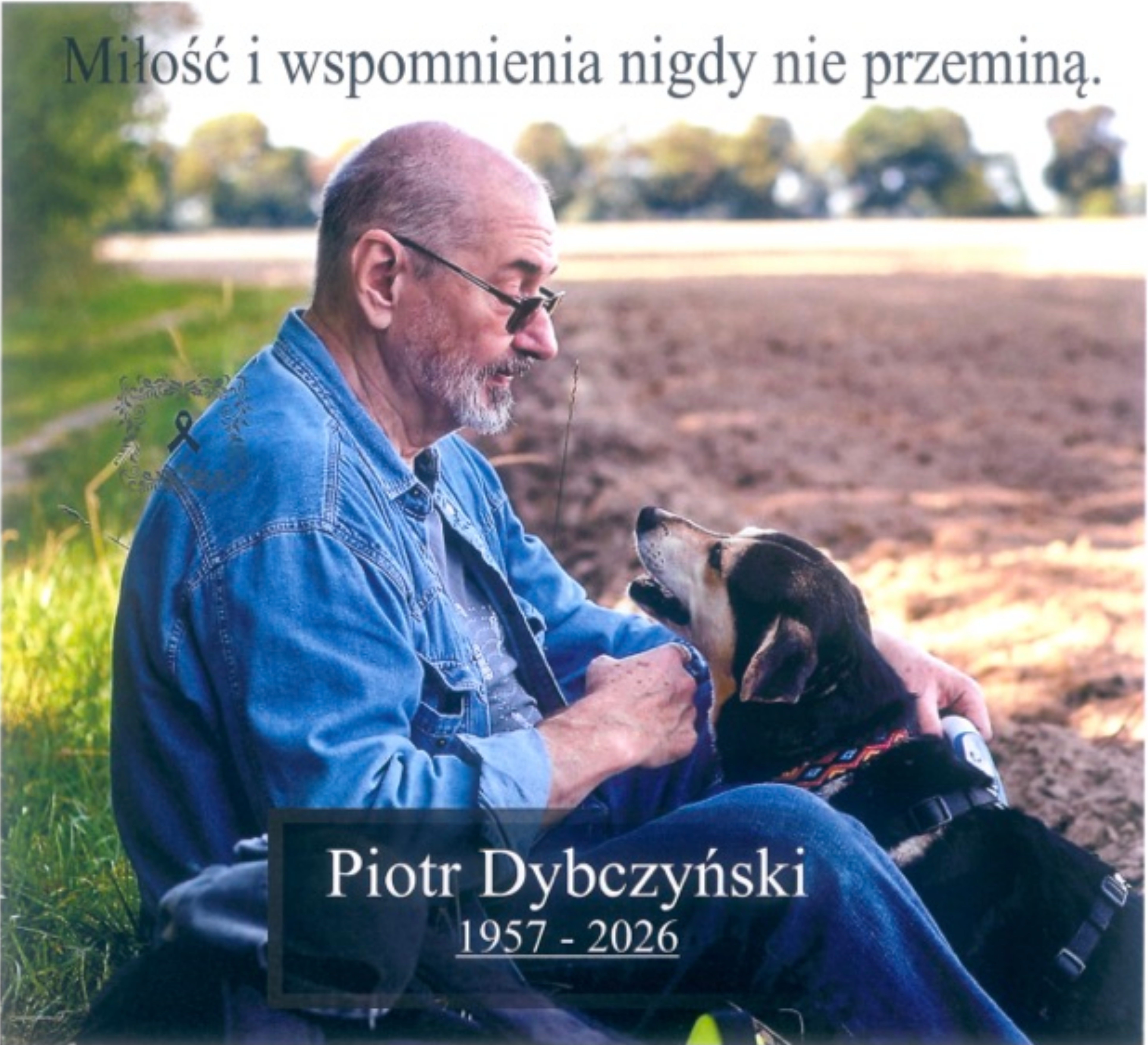
We are saddened to announce that on 11 April 2026, at the age of 68, our Colleague, Professor Piotr Andrzej Dybczyński of Adam Mickiewicz University, passed away.
Piotr Dybczyński was born on 14 May 1957 in Poznań, into a family of teachers at the State High School of Fine Arts – Rajmund (drawing) and Anna (Polish language). Contrary to family tradition, he was drawn to astronomy and, in 1976, after graduating from the VIII High School in Poznań, he began his studies in physics at Adam Mickiewicz University, choosing the specialization “astrometry and celestial mechanics” two years later. Even before completing his studies, he commenced work at the Astronomical Observatory, where on 15 December 1980 he assumed duties as a trainee in a technical assistant position. He received his Master’s degree in 1981 on the basis of a thesis entitled “Keplerian Orbits of Comets and Asteroids,” prepared under the supervision of Dr Edwin Wnuk. As a graduate, he was successively employed as a physicist (1981), assistant (1982), and, following the acceptance of his first article for publication, senior assistant (1985). In 1991, the Council of the Faculty of Mathematics, Physics and Chemistry of Nicolaus Copernicus University in Toruń awarded him the degree of Doctor of Physical Sciences (with distinction) on the basis of his dissertation “Stellar Perturbations in the Oort Cloud,” supervised by Professor Hieronim Hurnik. That same year, he was promoted to the position of assistant professor (adiunkt), which he held for the next 22 years, even after obtaining, in 2007, the degree of habilitated doctor in physical sciences (discipline astronomy), conferred by the Council of the Faculty of Physics, Astronomy and Applied Computer Science of Nicolaus Copernicus University upon submission of his habilitation thesis “Stellar and Galactic Perturbations and the Source of Long-Period Comets.” In 2013, he was appointed Professor of Adam Mickiewicz University, a position he continued to hold even after his retirement in 2022.
Professor Dybczyński’s great passions were computers and programming, as well as the orbits of comets. The beginnings of his scientific career coincided with the twilight of vast electronic mainframes, when first eight- and then sixteen-bit computers began to appear not only on office desks but also in private homes. When equipment for programming classes was scarce, he would make his own, precious ZX Spectrum available to students. A meticulously written and rigorously tested program – one in which no decimal place was left off control – formed the foundation of his scientific method. Although he began with relatively simple impulse-approximation models of stellar perturbations of comets, in his subsequent work he systematically raised the bar of precision in his models of motion, often lamenting the coarse approximations and hasty conclusions found in the work of his scientific competitors.
It is difficult to say whether working with computers – tolerating no error in a program – shaped his character, or whether his principled outlook on life drew him to programming. His strong adherence to rules and regulations made him a demanding examiner; yet he was respected by students, for he demanded no less of himself, devoting great effort to the careful preparation of his classes. He is also remembered with gratitude by students under his care during astronomical field camps. For three terms, from 2007 to 2019, he bore the considerable responsibilities of Deputy Director of the Institute for Teaching Affairs: he developed study programmes in the face of their increasing formalization and prepared the astronomy programme for accreditation.
Professor Piotr Dybczyński described himself as a legalist. He could not remain indifferent to conduct he regarded as an abuse of power, which led to his involvement first in the Solidarity trade union in the 1980s and later in the Committee for the Defence of Democracy.
Although he received well-deserved recognition for his scientific achievements (including the naming of the asteroid (30569) Dybczyński in his honour) and for his contributions to education (the Medal of the National Education Commission), he never rested on his laurels and worked until his sudden passing. His death came as a shock to us all and has left us with a profound sense of loss. One might at times have disagreed with him, yet even then he remained a good colleague, ever ready to offer advice or assistance.
The Requiem Mass and funeral services for the late Piotr were held on Friday, April 17th, in Tuchola. His ashes were then laid to rest at the municipal cemetery in Rudzki Most.
2026-04-13